
Yet another indicator of the partisan electoral imbalance in 2026
Democratic primary turnout is outpacing Republican turnout thus far

Political junkies are always looking for auguries of upcoming election results. This year is no exception. In this post, I want to highlight one more sign of things to come: primary turnout.
In the six states that held comparable statewide primaries in both 2022 and 2026—Arkansas, Illinois, Nebraska, North Carolina, Ohio, and Texas—the Republican-Democratic turnout ratio shifted toward Democrats in every case, with Democratic turnout up and Republican turnout down. This pattern is consistent with other evidence suggesting that Democrats currently hold the advantage in political energy, even if it is an imperfect predictor of the November results.
Election substitutes for the anxious
Predicting election outcomes is as old as political punditry. In a way, looking at current indicators of future outcomes is the appetizer for political obsessives: it settles the nerves while they wait for the main course.
There is no shortage of efforts to tell which way the political winds are blowing in 2026. Among these are prediction markets, presidential approval, vote intention, incumbent retirements, fundraising, special election outcomes, and election fundamentals.
All of these signs indicate heavy headwinds for Republicans in 2026. Kalshi investors are signaling a 74% chance that Democrats will take at least one chamber of Congress. President Trump’s net approval rating is the lowest of any president at this point in his term since national polling began and generic congressional vote-intention polls show a +5 Democratic advantage. Republicans are retiring from the House at near-record numbers, Republicans are lagging Democrats in fundraising, and Republicans have been experiencing a significant drop-off in support in special elections in 2025 and 2026.
Some of these signs have a better track record of forecasting than others. Presidential approval has long been central to midterm forecasting, and generic-ballot polling is also informative, although poll-based measures generally become more predictive as Election Day approaches. Fundraising is a noisier signal because money reflects not only a candidate’s strength but also how competitive or threatened a campaign appears to donors.
Despite the glut of auguries out there, I have another one to offer: turnout in the primaries.
Primary turnout as a sign of things to come
I’ve been following turnout in the current round of primaries, and I’ve noticed something interesting: relative to Republican turnout, Democratic turnout is up compared to 2022.
Before proceeding, I should clarify what I mean by primary turnout. Because few states report the total number of ballots cast in each party’s primary, I instead use the statewide contest in each party that drew the most votes. In other words, for each party in each state, I take the highest-turnout statewide primary as my measure of party turnout. In Ohio in 2026, for example, Democrats cast more votes in the U.S. Senate primary (791,355) than in the gubernatorial primary (762,457), so I use the Senate race to measure Democratic turnout. Republicans, by contrast, cast more votes in the gubernatorial primary (817,159) than in the Senate primary (733,270), so I use the governor’s race to measure Republican turnout.
This measure allows us to compare changes in raw turnout from 2022 to 2026. In each of the six states that have held statewide primaries in 2026 and also held statewide primaries in 2022, Democratic turnout has increased, while Republican turnout has decreased.1
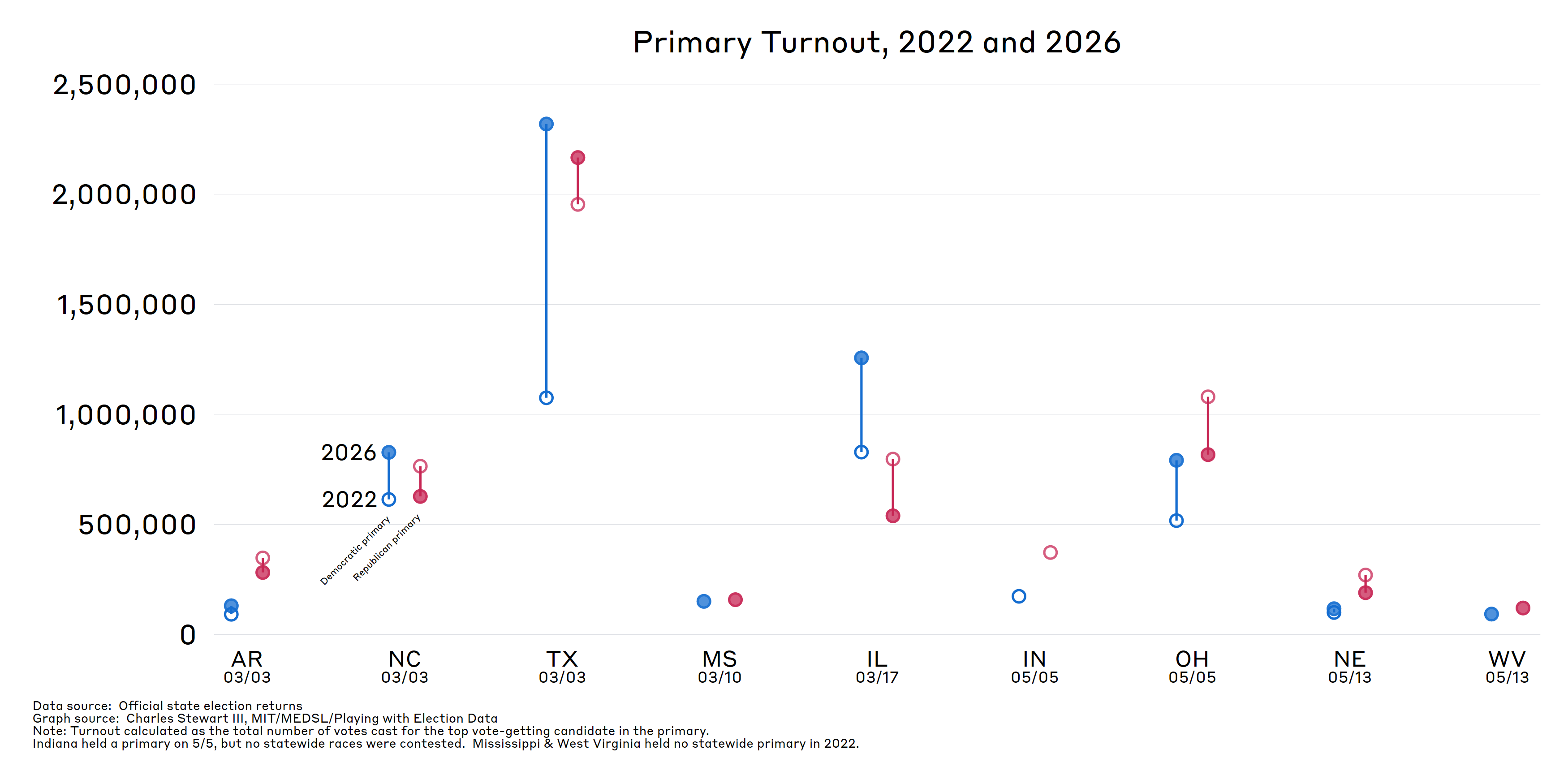
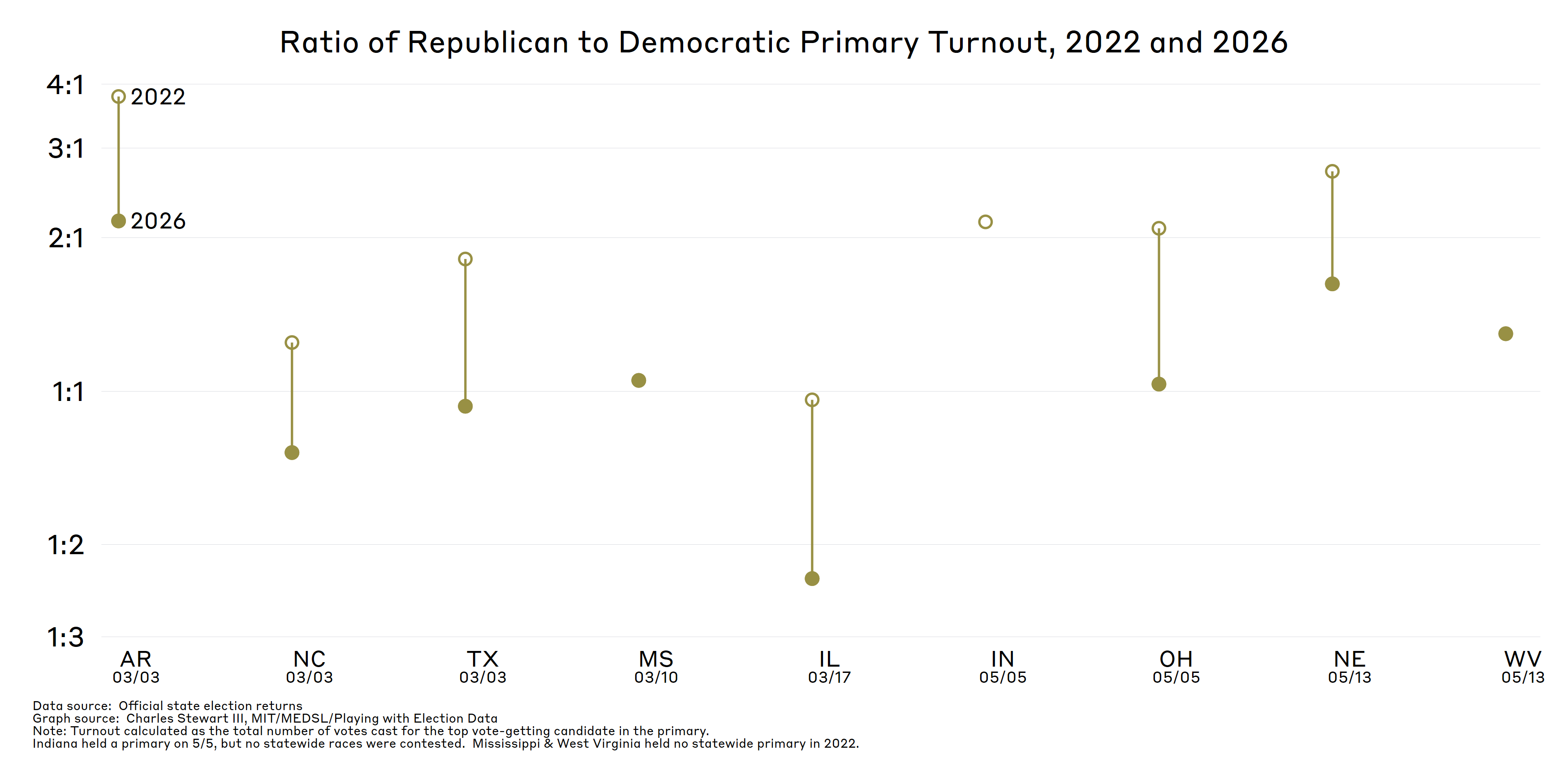
The raw numbers show the same directional story everywhere I look: Democratic turnout is up, and Republican turnout is down. But the cleaner way to compare states is by looking at the Republican-to-Democratic turnout ratio in each cycle. This helps normalize for differences in state population and baseline partisan support.
By that measure, the shift is evident everywhere. In deep-red Arkansas, the Republican turnout advantage fell from nearly 4:1 to just over 2:1, while in deep-blue Illinois, turnout moved from near parity to just over a 3:1 Democratic advantage. In Texas, Ohio, and North Carolina, the Republican advantage visible in 2022 gave way to something much closer to parity in 2026.
These turnout shifts are consistent with other signs, but let’s not get out over our skis quite yet
I can already hear the cries of, “Wait, wait, wait! There’s got to be much more to primary turnout than just partisan enthusiasm.” Those cries are correct, and can be confirmed by looking closely at the various races reflected in the data thus far.
Texas is a good example. In 2022, the top statewide primaries were for governor, and each party had a clear dominant candidate: incumbent Republican Greg Abbott and Democrat Beto O’Rourke, on the rebound from his close 2018 Senate loss to Ted Cruz. In 2026, by contrast, the marquee race was the U.S. Senate primary, and both parties had competitive nomination fights. That likely goosed turnout in 2026, independent of any broader partisan mood.
Analyses like this can be done for each state. Still, Texas shows why this indicator should not be interpreted mechanically. Competitive primaries can boost turnout independently of broader partisan mood. But they may also be part of the signal, because strong candidates are more likely to run when they sense favorable conditions. In general, when a party sees an opportunity, stronger candidates are more likely to run, more donors contribute, and more voters show up.
What about the past?
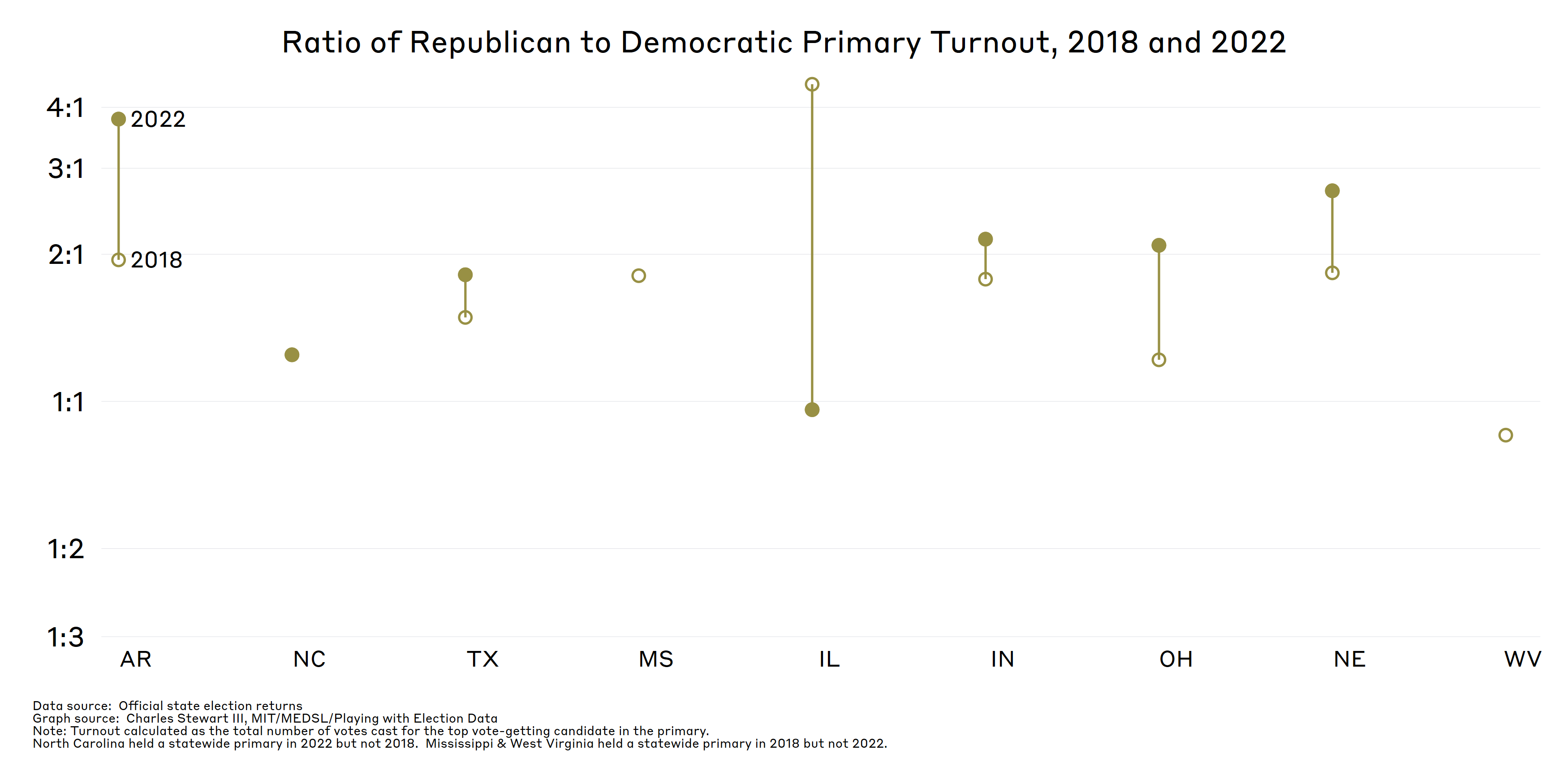
I’ve not found published political science research directly testing whether changes in partisan primary turnout ratios predict party performance in November. To see whether this is a potentially useful indicator, I looked backward. In the same states, I compared the shift from 2018 to 2022. Because 2018 was a much stronger year for Democrats than 2022 was, we would expect primary turnout ratios to have moved in a more Republican direction over that period. In five of the six states, that is exactly what happened.
Georgia preview
I will end the analysis by applying it to the upcoming Georgia primary. Georgia offers a useful test case because its primary is still ahead of us, but the advance-voting data already provide an early read on partisan participation. Once the results are released next Tuesday, we’ll know whether the Peach State saw a turnout shift in Democrats’ favor, but we can already see shifts in mail-ballot requests and in-person early voting.
Mail-ballot requests are down by about 50% compared to 2022; early in-person voting is also down overall, but not by nearly as much. As of yesterday (Thursday, May 14), 45,800 mail ballots have been requested, compared with more than 90,000 at the same point in 2022. In contrast, more than 714,000 early votes have been cast, compared with nearly 800,000 in 2022.2
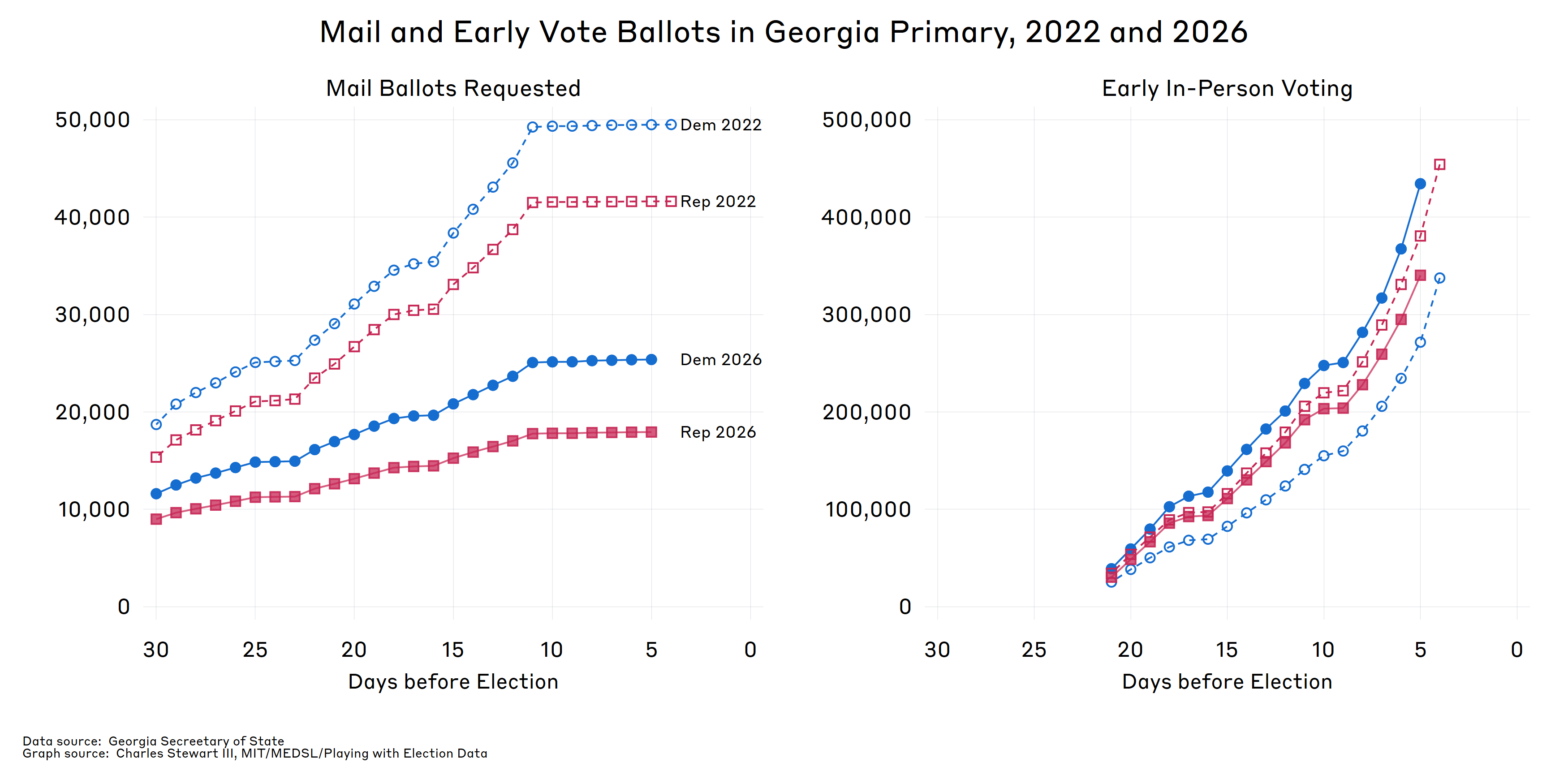
For the purposes of this post, the key question is not the overall level of advance voting but the partisan balance within it. This year, as in recent Georgia elections, Democrats outpaced Republicans in requesting mail ballots. More interesting is that significantly more Democrats have turned out to vote early in person this year, whereas the opposite was true in 2022.
To make this point more directly, I turn again to the graphs that plot the ratio of Republican-to-Democratic use of mail ballots and early in-person voting. By this measure, Democrats are slightly outpacing Republicans in requesting mail ballots compared to 2022. This is in sharp contrast to in-person early voting, where, in 2022, Republicans outpaced Democrats by 40%; in 2026, Republicans are falling behind Democrats by 20%.
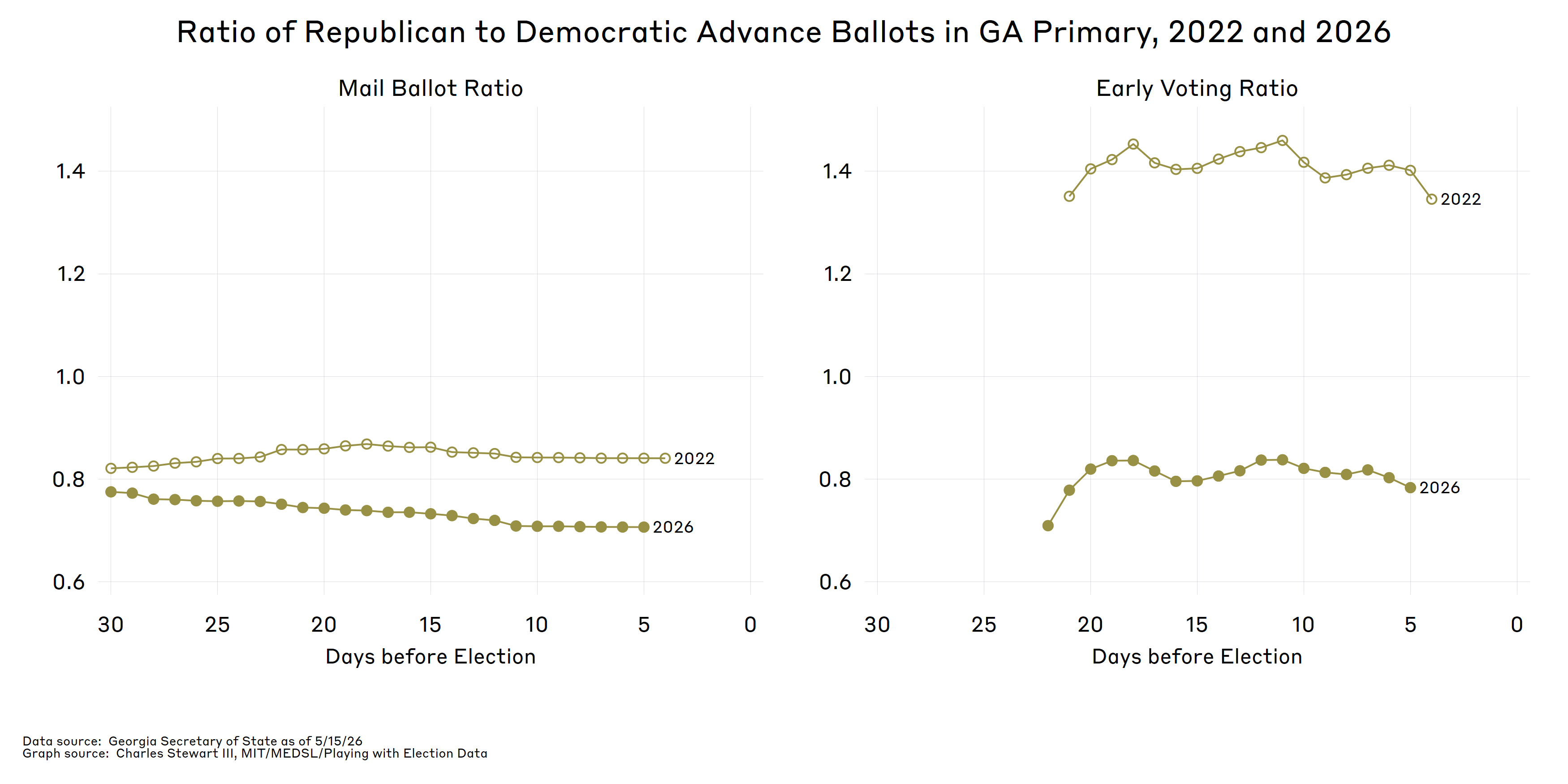
[5/16/26 update: For updates of these two graphs, check out this Twitter post:]


As I mentioned above, lots of things affect primary turnout, and it’s not always predictive of outcomes in the general election. In every comparable statewide primary held so far, the turnout ratio has moved toward Democrats. That doesn’t guarantee anything in November, but it’s another sign that 2026 is shaping up to be a favorable environment for them.
Mississippi did not hold a statewide primary in 2022, but it did hold statewide gubernatorial primaries in 2023. In those races, 376,472 votes were cast in the Republican primary and 196,307 in the Democratic primary. If Mississippi’s 2023 primary were used as the comparison point, it would fit the same directional pattern.
Nearly 26,000 ballots have been returned. I’m focusing on requests because, even at this point in the calendar, returns are still catching up to requests and therefore provide a less stable early read.
The will of the people might swing but how we cound their positions should not be precarious