
Will Georgia extend the Democratic shift in primary turnout?
Plus, Louisiana’s primary points in the same direction, too

Today is Georgia’s primary, so I’m dashing off this quick post to follow up on last week’s longer analysis of the pro-Democratic shift in turnout this year. In that post, I noted that Georgia’s advance voting pattern looked consistent with the same shift extending to the Peach State.
Since then, I’ve taken a closer look at Georgia’s voter history file. The individual-level evidence points in the same direction: compared with four years ago, Democratic primary voters appear more engaged than Republican primary voters. Louisiana’s primary last Saturday points in the same direction, too, although the comparison there is less clear because Louisiana has just changed its primary system.
Georgia’s voter history file confirms greater Democratic engagement this time around
Starting with Georgia, I pulled down the voter history file from the 2022 and 2026 primaries and compared how individuals who voted in 2022 have voted thus far in 2026.
First, an explanation. Much to its credit, Georgia posts voter history files online for anyone to download. These files record which registered voters cast ballots in particular elections. Because Georgia includes a unique voter identification number, researchers can track whether the same individual voted across multiple elections.
One important detail is that Georgia is an “open primary” state. Any registered voter can request either party’s ballot—or a nonpartisan ballot—in the primary. This allows independents to participate in partisan primaries and allows voters who usually identify with one party to cross over and vote in the other party’s primary. Crossover voting happens less often than many people think, but even modest crossover can tell a story.
Back to the data. Merging the two voter history files shows, first, that of the 1,030,367 people who cast an advance vote in 2026—either by mail or early in person—471,981 cast an advance vote in 2022, 231,614 cast an Election Day ballot, and 326,772 didn’t vote in the 2022 primary.
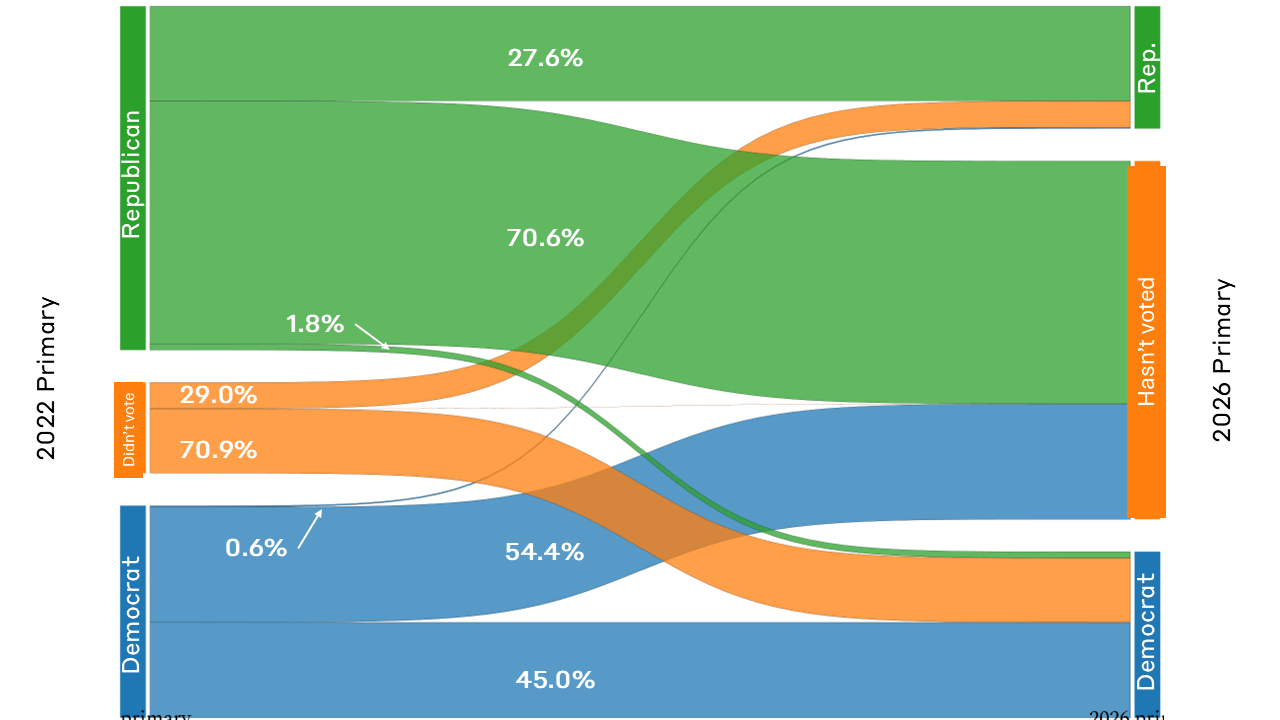
Second, the party-ballot patterns among both repeat primary voters and new 2026 primary voters tilted toward the Democrats. With apologies for the color scheme, the details are shown in the accompanying graph.1 Among the highlights:
Among 2022 Republican primary voters, 27.6% had already voted in this year’s primary, compared to 54.4% of 2022 Democratic primary voters.
Among 2026 advance voters who did not vote in the 2022 primary, 70.9% took a Democratic ballot and 29.0% took a Republican ballot.
Among those who took a Democratic ballot in 2022 and have already voted, only 0.6% took a Republican ballot in 2026, compared to 1.8% who took a Republican ballot in 2022 and then took a Democratic ballot in 2026. (I told you crossover voting was uncommon, but it can still tell a story.)
At the end of the night, we’ll see whether these trends carry over to Election Day voting. My expectation is that the Democratic share of Election Day votes will also be higher than it was in 2022, though probably not by as much as in the advance-voting period.
One possible explanation is that the advance-vote pattern simply reflects the continuing partisan separation in voting modes. I’m skeptical of that explanation, though I could be wrong. Another possibility is that more Republican voters are still weighing their choices and therefore waited until Election Day.
A word about Louisiana
Louisiana’s primary was on Saturday. Louisiana has long been famous for its “jungle primary,” in which all candidates appear on the same ballot, regardless of party. If no candidate wins a majority, the top two vote-getters advance to the general election. In 2024, the state changed the law so that, starting in 2026, candidates for certain federal and state offices would run in partisan primaries. For that reason, it’s not possible to directly compare 2026 turnout in the partisan primaries to 2022. An alternative is to compare Saturday’s primary turnout with the votes received by Donald Trump and Kamala Harris in Louisiana in 2024.
The unofficial results posted by the Louisiana Secretary of State as of this morning (May 19) show 344,751 votes cast in the Democratic primary for U.S. Senate and 401,119 votes cast in the Republican primary. Compared to the presidential numbers (766,870 for Harris and 1,208,505 for Trump), that works out to a 45.0% rate for the Democratic primary and 33.2% in the Republican primary.
Again, this isn’t an apples-to-apples comparison like I’ve made for other states, but it seems to continue the trend of the most engaged Democratic voters being more eager to participate in primaries than the most engaged Republican voters.
To simplify things, I have omitted voters who received a non-partisan ballot in either 2022 or 2026. This eliminated 39,792 voters from the analysis.]
Beautiful graph, Charles!